The Evolution of Artificial Intelligence: From Rule-Based Systems to the Battle of GPT, Gemini, and Claude
Artificial Intelligence has evolved from simple rule-based systems to powerful generative models that can create content, solve problems, and assist humans in complex tasks. Today, fierce competition between ChatGPT, Gemini, Claude, and other AI platforms is driving rapid innovation and shaping the future of technology, business, and everyday life.
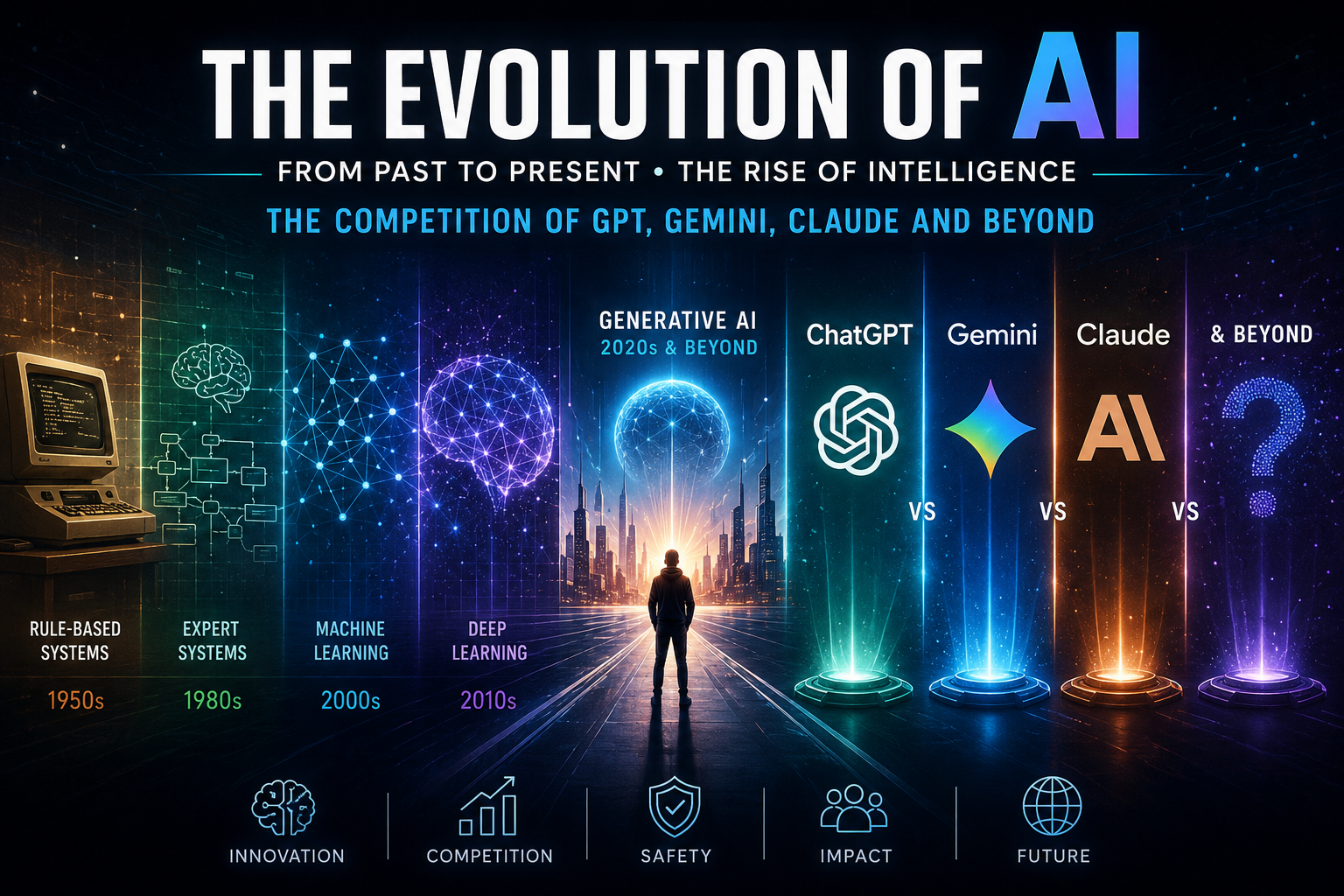
Artificial Intelligence (AI) has transformed from a futuristic concept into one of the most influential technologies of the 21st century. Over the last few decades, AI has evolved from simple rule-based programs to advanced generative models capable of understanding, creating, and reasoning with human-like language. Today, the AI landscape is dominated by fierce competition among leading companies such as OpenAI, Google DeepMind (Gemini), and Anthropic, alongside competitors like Meta AI, xAI, and Microsoft AI.
This article explores the evolution of AI, the rise of Large Language Models (LLMs), and the ongoing competition among today's AI leaders.
The Early Days of AI (1950s–1990s)
The concept of AI began in the 1950s when researchers sought to create machines capable of mimicking human intelligence.
Key Milestones
1950: Alan Turing proposed the famous Turing Test.
1956: The term "Artificial Intelligence" was officially introduced at the Dartmouth Conference.
1970s–1980s: Expert systems became popular, using predefined rules to solve specific problems.
1997: IBM's Deep Blue defeated world chess champion Garry Kasparov.
While impressive, these systems lacked learning capabilities and relied heavily on human-programmed rules.
The Rise of Machine Learning (2000–2015)
The growth of computing power, internet data, and cloud infrastructure enabled a new era of AI: Machine Learning (ML).
Instead of following fixed rules, machines could learn patterns from data.
Major Advancements
Image recognition systems achieved unprecedented accuracy.
Recommendation engines powered platforms like Netflix and Amazon.
Speech recognition became practical through virtual assistants such as Siri and Google Assistant.
This era laid the foundation for deep learning and neural networks.
The Deep Learning Revolution (2012–2020)
Deep learning dramatically improved AI performance across multiple domains.
Breakthrough Technologies
Convolutional Neural Networks (CNNs) for image processing.
Recurrent Neural Networks (RNNs) for sequence prediction.
Transformers, introduced in 2017 through the groundbreaking paper "Attention Is All You Need."
The Transformer architecture changed everything by enabling AI systems to process vast amounts of information efficiently.
This innovation became the foundation of modern generative AI.
The Generative AI Boom (2020–Present)
Generative AI models can create text, images, code, audio, and videos.
The release of GPT models sparked a global AI race.
What Makes Generative AI Different?
Modern AI can:
Write articles and reports
Generate software code
Create marketing content
Analyze complex documents
Produce images and videos
Act as digital assistants
Businesses worldwide now integrate AI into customer service, software development, healthcare, education, and research.
The AI Competition: GPT vs Gemini vs Claude
1. ChatGPT (OpenAI)
Strengths
Excellent conversational ability
Strong coding capabilities
Broad knowledge base
Extensive ecosystem and integrations
Key Models
GPT-3.5
GPT-4
GPT-4o
GPT-5 series
Market Position
ChatGPT popularized generative AI and remains one of the most widely used AI assistants globally.
Best For
Writing
Programming
Research assistance
Business productivity
2. Gemini (Google DeepMind)
Strengths
Deep integration with Google's ecosystem
Strong multimodal capabilities
Access to search and real-time information
Advanced reasoning abilities
Key Models
Gemini 1.0
Gemini 1.5
Gemini 2.x
Competitive Advantage
Google's massive data infrastructure and search expertise provide Gemini with strong contextual understanding and real-time information access.
Best For
Research
Productivity
Google Workspace integration
Multimodal tasks
3. Claude (Anthropic)
Strengths
Long-context processing
Strong document analysis
Safety-focused design
High-quality writing
Key Models
Claude 2
Claude 3 Family
Claude 4 Family
Competitive Advantage
Anthropic emphasizes AI safety and constitutional AI principles, making Claude highly reliable for enterprise use.
Best For
Long reports
Legal documents
Strategic analysis
Enterprise applications
Other Major AI Competitors
Meta AI
Developed by Meta AI, the Llama family of models has accelerated open-source AI development.
xAI
Founded by Elon Musk, xAI focuses on advanced reasoning systems and AI-powered assistants.
Microsoft AI
Microsoft has heavily invested in OpenAI while integrating AI into products such as Windows, Azure, and Microsoft 365.
Mistral AI
Mistral AI has emerged as a major European player emphasizing efficient and open-weight AI models.
Challenges Facing AI
Despite rapid progress, AI still faces significant challenges:
1. Hallucinations
AI systems can generate incorrect information confidently.
2. Privacy Concerns
Organizations must protect sensitive data when using AI.
3. Regulation
Governments worldwide are developing AI governance frameworks.
4. Ethical Considerations
Bias, transparency, and accountability remain ongoing concerns.
5. Computational Costs
Training advanced AI models requires enormous computing resources.
The Future of AI
The next phase of AI development is expected to include:
More powerful reasoning capabilities
Autonomous AI agents
Improved multimodal understanding
Personalized AI assistants
AI-powered scientific discovery
Greater integration into everyday life
Competition among OpenAI, Google, Anthropic, Meta, xAI, and emerging startups will continue driving innovation at an unprecedented pace.
Conclusion
Artificial Intelligence has evolved from simple rule-based systems into highly sophisticated generative models capable of performing tasks once thought exclusive to humans. The competition between ChatGPT, Gemini, Claude, and other leading AI systems is accelerating innovation and reshaping industries worldwide.
While no single AI model is perfect, each brings unique strengths to the market. As technology advances, the real winners will be individuals and organizations that learn how to effectively leverage AI to enhance productivity, creativity, and decision-making.
AI is no longer a technology of the future, it is a transformative force shaping the present and defining the future of humanity.