AWS vs Azure vs Google Cloud for AI: Which Platform Should You Choose?
Artificial Intelligence has become one of the biggest drivers of innovation across industries. Whether you're building chatbots, recommendation systems, computer vision applications, or large language model (LLM) powered solutions, choosing the right cloud platform can have a sig…
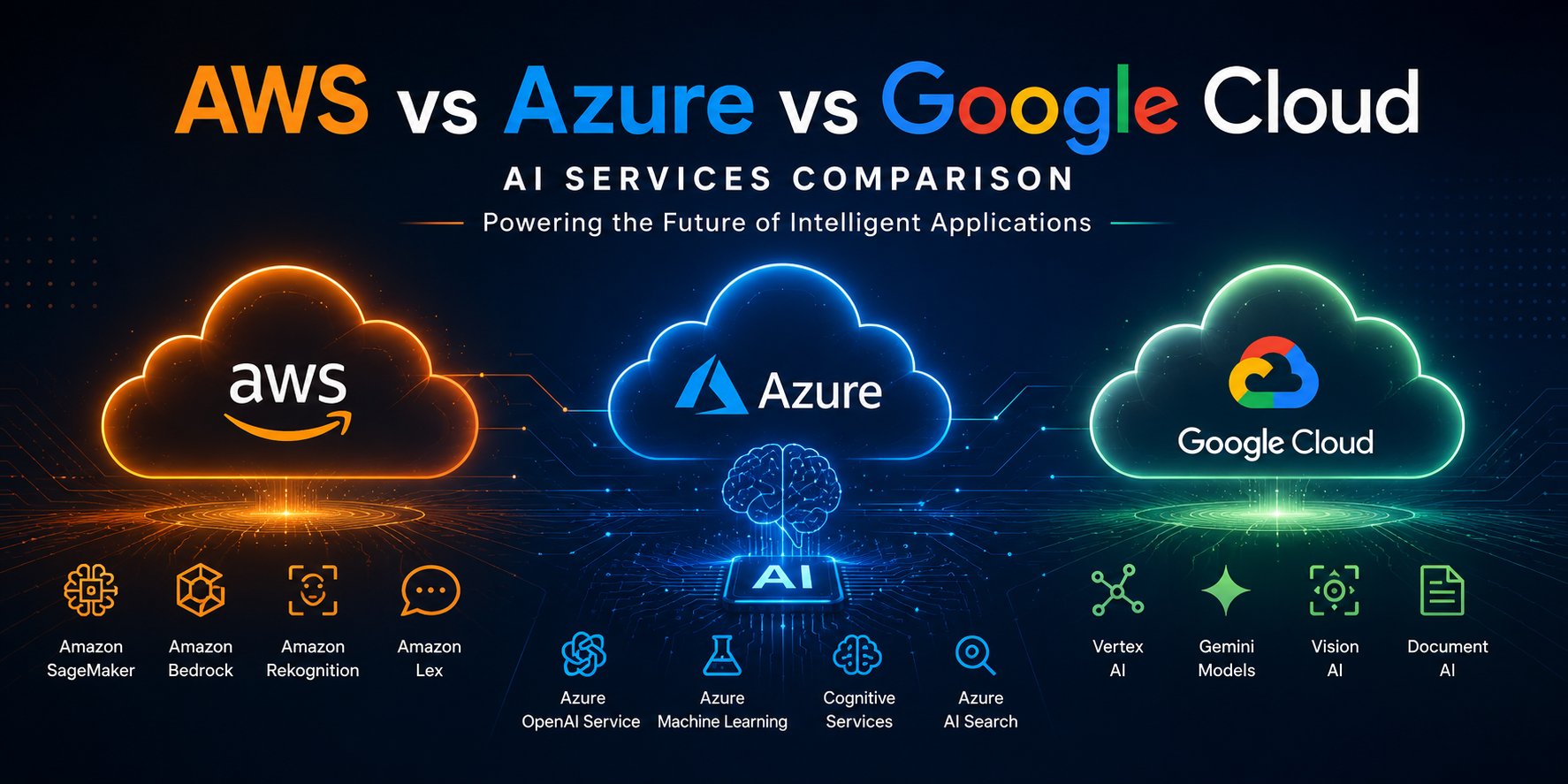
Artificial Intelligence has become one of the biggest drivers of innovation across industries. Whether you're building chatbots, recommendation systems, computer vision applications, or large language model (LLM) powered solutions, choosing the right cloud platform can have a significant impact on your project's success.
The three major cloud providers, Amazon Web Services (AWS), Microsoft Azure, and Google Cloud Platform (GCP), all offer powerful AI and machine learning services. While they share many similarities, each platform has its own strengths and ecosystem.
Let's take a closer look at what each cloud provider offers for AI development.
Amazon Web Services (AWS)
AWS is the largest cloud provider in the world and offers a wide range of AI and machine learning services for businesses of all sizes.
Some of the most popular AI services include:
Amazon SageMaker
Amazon SageMaker is AWS's flagship machine learning platform. It helps data scientists and developers build, train, and deploy machine learning models at scale.
Amazon Bedrock
Amazon Bedrock provides access to foundation models from providers such as Anthropic, Meta, Stability AI, Cohere, and Amazon Titan. Developers can build generative AI applications without managing infrastructure.
Amazon Rekognition
This service enables image and video analysis, including object detection, facial analysis, and content moderation.
Amazon Comprehend
A natural language processing service that can analyze text, detect sentiment, identify entities, and extract key insights.
Amazon Lex
AWS's conversational AI service used to build chatbots and virtual assistants.
Best for:
Organizations that need a mature cloud ecosystem, strong scalability, and a broad range of AI services.
Microsoft Azure
Microsoft Azure has become a major player in AI, especially because of its close partnership with OpenAI.
Azure provides enterprise-grade AI tools while integrating seamlessly with Microsoft products such as Office 365, Dynamics 365, and Power Platform.
Azure OpenAI Service
Provides secure access to advanced AI models including GPT models and other OpenAI technologies within the Azure environment.
Azure Machine Learning
A complete platform for building, training, deploying, and managing machine learning models.
Azure AI Studio
A unified environment for creating generative AI applications and managing AI workflows.
Azure Cognitive Services
A collection of pre-built AI services for vision, speech recognition, language understanding, and translation.
Azure AI Search
Combines enterprise search with AI-powered retrieval and knowledge discovery.
Best for:
Enterprises already invested in Microsoft technologies and organizations building production-grade AI applications using OpenAI models.
Google Cloud Platform (GCP)
Google has been at the forefront of AI research for years, making Google Cloud a natural choice for AI and machine learning workloads.
Many of Google's AI innovations, including TensorFlow and Gemini, are available through its cloud platform.
Vertex AI
Vertex AI is Google's unified machine learning platform. It allows teams to build, train, fine-tune, and deploy AI models from a single environment.
Gemini Models
Google's latest multimodal AI models can understand and generate text, images, code, and other forms of content.
AutoML
Allows users to create custom machine learning models with minimal coding experience.
Vision AI
Provides image classification, object detection, OCR, and video intelligence capabilities.
Document AI
Designed for extracting and processing information from invoices, forms, contracts, and other business documents.
Best for:
Companies focused on advanced AI research, large-scale analytics, and data-driven machine learning projects.
Comparing the Three Platforms
FeatureAWSAzureGoogle CloudMachine Learning PlatformSageMakerAzure MLVertex AIGenerative AIBedrockAzure OpenAIGemini & Vertex AIComputer VisionRekognitionVision ServicesVision AINLP ServicesComprehendLanguage ServicesNatural Language AIEnterprise IntegrationExcellentExcellentVery GoodData AnalyticsStrongStrongOutstanding
Which Cloud Platform Should You Choose?
The answer depends on your requirements.
Choose AWS if you need the widest range of cloud services and a highly scalable environment.
Choose Azure if your organization already relies on Microsoft products and you want direct access to enterprise-ready OpenAI capabilities.
Choose Google Cloud if your focus is AI innovation, machine learning research, and advanced data analytics.
The good news is that all three platforms provide world-class AI capabilities. The best choice is often the one that aligns most closely with your existing infrastructure, team expertise, and business goals.
As AI adoption continues to grow, AWS, Azure, and Google Cloud will remain the foundation for building the next generation of intelligent applications.
Discussion
Loading responses…